 ™
How to solve your first word ladder
Check each one-letter move, compare two routes from LAC to BUS, and try a four-letter puzzle with hints.
Learn to play
Three checks for every move
Imagine the letters L, A, and C on a board. Your goal is to make BUS. Both are three-letter words in French, and all three positions differ. To reach BUS, you need to put new letters in those positions while forming a valid word on every move. You could type “bus” in an instant. The puzzle is what happens between the starting word and the target.
To check a move, start by counting the letters. A word ladder of three letters remains a word ladder of three letters. Then, compare the words from left to right. Only one position must change. Finally, read the entire result. The change from LAC to BAC meets the three conditions. There are always three letters, only L has become B and a bac is a common word. Switching from LAC to BAL in one motion fails the second check. The middle remains A, but the letters on each side have changed.
The order of tiles also counts. LAC and CAL use the same three letters. By aligning them, we see two differences, at the beginning and at the end. The fact that all the letters are already present does not make the exchange possible in one move. A good habit is to point the position that you modify before saying the word you want to get. On paper, you can highlight this letter or surround the box.
Solve your first word ladder
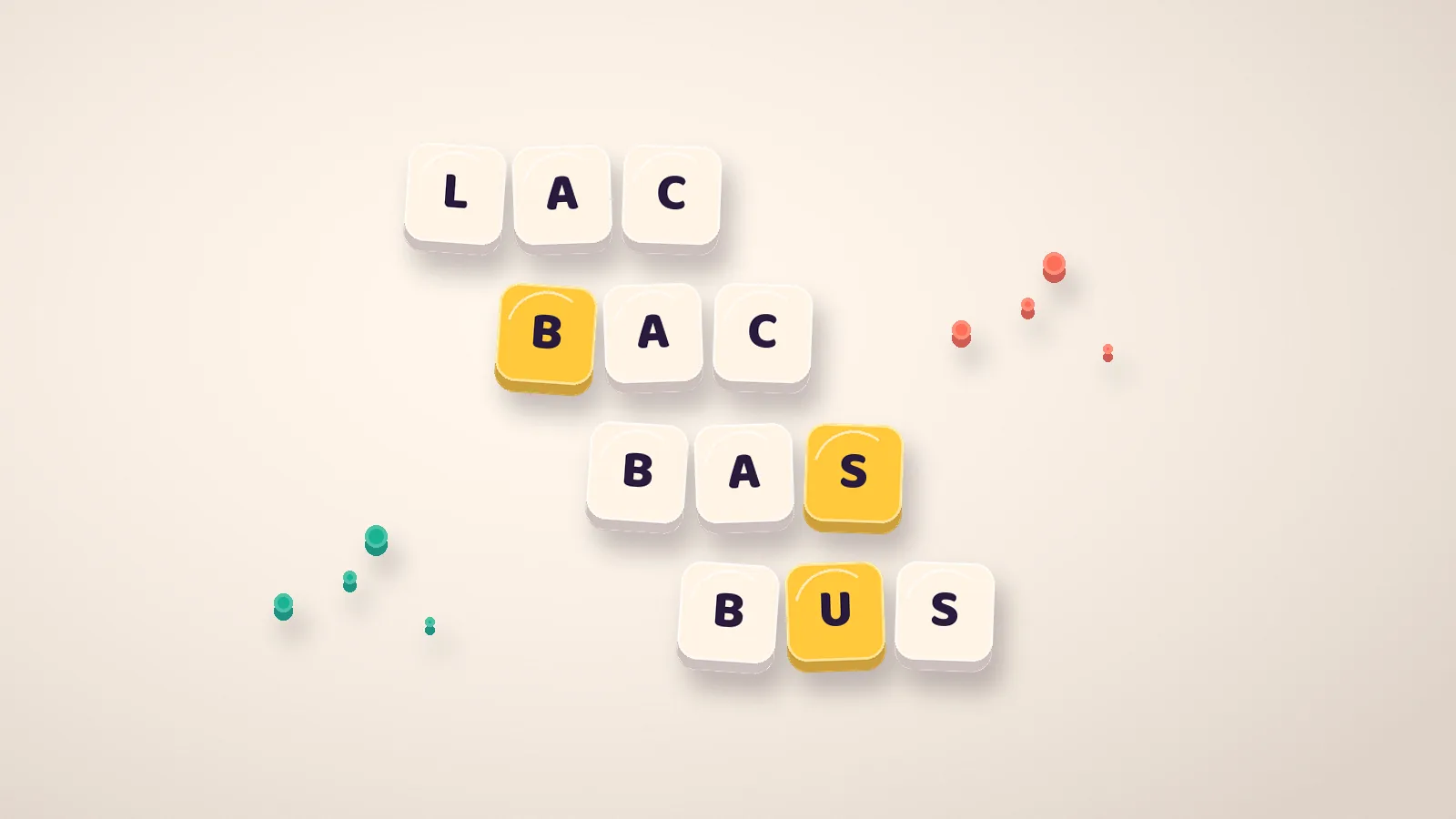
Write LAC and BUS under each other. Mentally try to take a letter from the target word and place it in the same place in the starting word. Change L to B gives BAC. This first move installs a letter that can remain in place. Then look for a word that starts with BA and ends with a different letter from C. You can say a few beginnings of words aloud. The word BAS is a familiar option. Now, only the vowel to be replaced remains.
LAC → BAC → BAS → BUS
Reread the word ladder from left to right. B arrives at the first move and remains in place. S arrives at the second move. U arrives at the third. From LAC, the three positions are different from BUS. Since one move can only touch one position, it takes at least three. One has just found a word ladder in three moves. There is therefore no shorter course, even if another course of the same length can exist.
If you started with another idea, look at what this idea taught you. By replacing C with a S from the start, you get LAS. It's a word that may mean “fatigué”. From LAS, you can also move to BAS, then BUS. This second solution changes the same three positions in another order. In the first part, see two good answers helps to understand what is assessed. The game checks the validity of the moves and the number of steps. The way to discover the path belongs to you.
LAC → LAS → BAS → BUS
Three common mistakes
The first is to confuse a letter with a sound. In a word ladder, the positions are those of the writing. If two words are pronounced in a close manner, still examine the letters on the page. Conversely, changing a single letter can change a fairly large part of what you hear. The move is evaluated in writing. To verify, it is often enough to place the two words on two lines and match each box.
The second is to treat a familiar word as an automatic shortcut. Starting from LAC, the word SAC comes to mind easily. It is a good move in the sense of the rule, but it does not place any letter of BUS. It could be useful for another objective. In this challenge, try to note what really brings the course closer to the target. You can always explore a neighbour who deviates from it if the direct moves close the road.
The third is to count words instead of moves. LAC, BAC, BAS and BUS form a list of four words. The first is already on the set when you start. Only the three passages between the words count. If you write an arrow between each pair, the number of arrows corresponds to the number of moves. This distinction becomes useful when you compare two solutions or when you propose a riddle to someone.
Try a four-letter puzzle
Take now PONT as departure and FORT as arrival. Before looking for a solution, place the two words one above the other. Mark the different positions. Then take two separate essays. In the first, start by touching the first letter. In the second, start with the third. You can leave a line free under each essay and write only the words that you think are admissible. When an essay gives a result that looks like nothing, keep the starting word and try the other position.
See two possible routes
PONT → PORT → FORT
PONT → FONT → FORT
PORT changes the N to R and leaves the P for the end. FONT, a form of the verb do, first place the F and leaves the third letter for the next move. In both cases, the second and fourth letters have never moved. Try to explain why two changes are necessary before showing someone your solution.
Check a move someone suggests
Here's a last way to train before opening the demo. Give the words BAC, BAS and BUS to someone and ask them to propose a single change. If the person goes directly from BAC to BUS, leave the two visible forms and ask them to find out which boxes have changed. They will see that the vowel and end must be touched. Then ask if one of the three words provided could be used as a walk between the two. By playing the role of auditor, you practice the same look as you use when you try to find a way.
For your next game, keep this little order of work. Align the two words. Find a position. Read the whole neighbor. After a few attempts, the rhythm becomes natural and you can devote your attention to the interesting part of the game, the discovery of a word that opens the way.
Once you’ve solved your first ladder, learn how to make a word ladder puzzle with hints.