 ™
French word ladder puzzle: POMME to POIRE
Try the French puzzle from POMME to POIRE. Use three hints, then explore why changing two positions can take a seven-move detour.
Puzzle walkthroughs
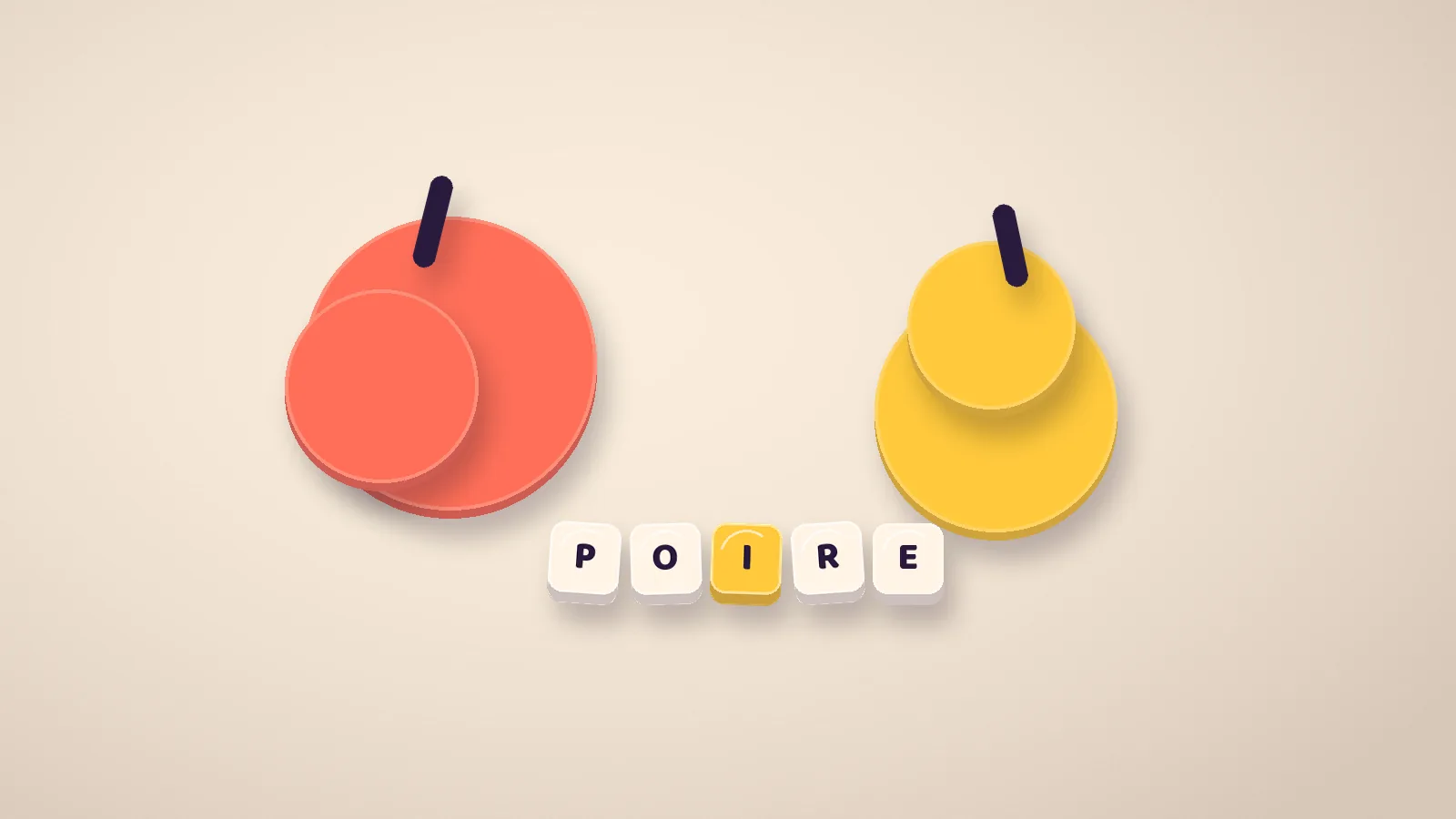
Two differences and a long detour
The French words POMME and POIRE share P, O, and E in the same positions. The third and fourth letters have to change. The direct replacements give POIME or POMRE. WordHop’s French dictionary accepts neither. For this puzzle, you’ll temporarily move away from PO and restore it near the end.
Before opening the clues, write the two ends on a sheet and highlight the common squares. You can first try a search that keeps the P. Note the neighbors you know and read each in full. If you want to test a second step, choose a neighbour who starts with another letter. Note what familiar words then become possible. The objective of the challenge is to discover what connects the universe of POMME to that of POIRE. You can leave a trail on the paper and move on to the other side for a moment.
Allow yourself the right to find a longer route before trying to shorten it. To compare two solutions, first check the words and letters, then count the moves. In this riddle, keeping at least one word of reference on each side makes the essays easier to classify. For example, ask yourself what five-letter verb describes the action of pouring a liquid into his mouth, then ask what rank he stands out from POIRE.
Three hints
Hint 1 – Start from the target
Replaces P with B in POIRE. You get BOIRE. Since BOIRE, changes R to T. The word is written BOÎTE in a text. On the tray it takes the form BOITE. From BOITE, think of the quality of a person who acts kindly.
Hint 2 – Change the first letter of POMME
Since POMME, replace P with C. The word can be used to make a comparison, for example in “léger ___ une plume”. Keep this C for the two moves that follow. Once COMME writes, look for the title of nobility that changes its fourth character.
Hint 3 – Connect the two routes with a story
Since COMTE, modify the third letter to obtain a story, for example a fairy tale. This word is only a move of the quality sought at the first index. Replaces C by B. In everyday writing, this last word carries an acute accent.
The seven-move word ladder
Show the full solution
POMME → COMME → COMTE → CONTE → BONTE → BOITE → BOIRE → POIRE
P became C at the beginning. The fourth position then changed from M to T. In the third position, M became N. The early C became B, the middle N became I and the T became R. The last transition returned the P to first place.
Look at the place of the first letter. It changes three times while it is identical to the beginning and the arrival. C opens the words COMME, COMTE and CONTE. B opens BONTÉ, BOÎTE and BOIRE. P arrives as soon as the rest of the word is ready. This method corresponds to a useful decision being searched. You agree to touch an already correct box to reach another set of words, then you fix the box after the detour.
The graphs also give a mini-exercise. COMTE refers to a title, while CONTE refers to a story. In the spoken word, these two words are pronounced in the same way in common use. In writing, they differ from a consonant. BONTÉ and BOÎTE contain signs that the French plateau simplifies to evaluate the changes. Each passage in the word ladder counts on the tiles. You can use normal writing when you explain the meaning of one of the words to another person.
A search by layers of neighbours in the lexicon of the game confirms that seven moves constitute the minimum for this pair. If you want to reproduce the idea on paper, first write the possible neighbours from the start to a move. Then build the neighbours you first meet in the second move, then continue so. As soon as a layer contains the target, its distance is that of the layer. Doing this check by hand can be long. You can check a beginning of diaper and see why the minute of exploration has made you discover unexpected words.
Share the puzzle with someone else
Trace a letter that comes back
Draw five numbered columns and copy the solution. First follow only the left column with your finger. You will see P, then a series of C, then a series of B and finally P. Under the columns, note the transitions that affect each one. Now you can tell the riddle as a story of positions. The beginning moves away to let the middle work and returns when the word contains O, I, R and E in the right order.
The approach gives a good variant to play with two. One person only has before him the changes of the first column, and the other knows BOITE and BOIRE. Together, look at when the C must become B. If you block, ask yourself what word can follow CONTE by touching only the beginning. When BONTE appears, just compare the third position with BOITE. The other columns can stay in place on this move.
To extend the exercise without adding a complete challenge, ask the other person to write two sentences, one with “comte” and the other with “conte”. Read them and return to the tiles to find the place of M and N. The same game makes you move from checking the letters to recognizing the meaning.
Give the two fruits and announce only that a path exists. After a few tests, propose the side that seems most useful to the other person. If she has already found COMME, give the index that starts from POIRE. If she found BOIRE, invite her to touch P of POMME. Once the solution is read, ask her to reconstruct the journey with the usual prints. She can explain the passage from title to history and the passage of quality to the container. The handful of intermediate words then forms a small narrative that the two fruits frame.