 ™
Word ladders in French, English, and Spanish
Compare three WordHop puzzles to see how each language’s dictionary changes the possible opening moves and routes.
Words and languages
Take the same rule into another language
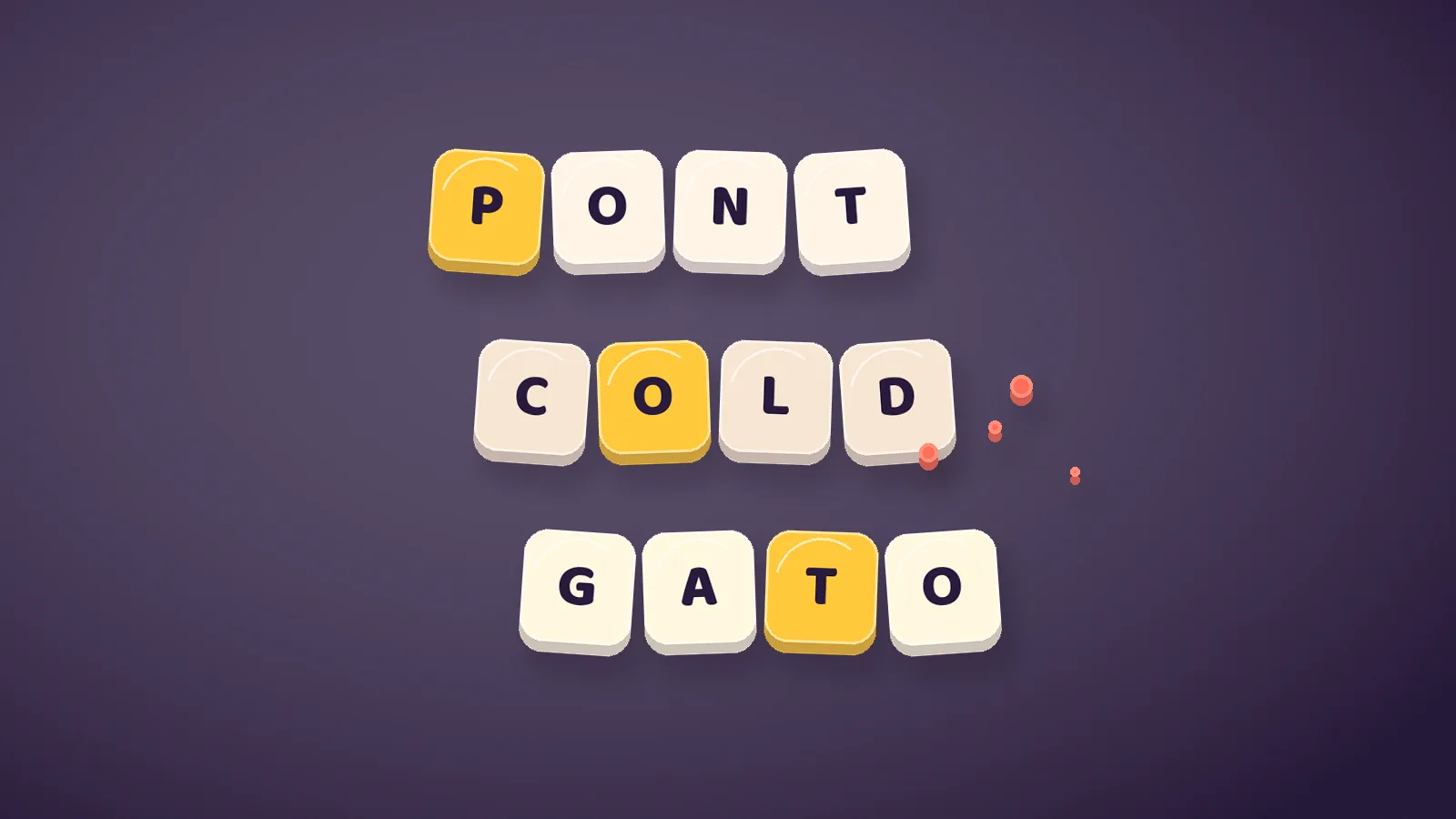
WordHop uses the same rule in French, English, and Spanish. Replace one letter and form a word the game accepts. Each language has its own dictionary, so a familiar-looking spelling won’t necessarily be allowed in each version. Play the three demos in succession and watch for two things. Comparing positions works the same way. Finding a word that connects them depends on the vocabulary.
Try to read the three examples before touching the set. Then, compare the departure and arrival of each pair and indicate where you see two differences. French and English allow a solution that first changes the third letter. The Spanish shown here starts with the first. When you switch from one language to another, keep the same question for the first move. Which neighbour gives you access to the target word?
Two familiar opening moves in French
PONT → PORT → FORT
PONT and FORT keep the O and the T. PORT changes the third letter and keeps the P for the end. The reverse move in the order of positions is also possible. FONT place first the F, then FORT receives the R. PORT designates a place where ships can dock. FONT is a conjugated form of doing. Grammatical categories can vary from one step to another, and the word ladder remains valid as long as the words are allowed by the lexicon.
PONT → FONT → FORT
Test the two orders without looking at the above string. Keep the two common letters in your sheet and give a sentence for the chosen intermediate word. If the idea of reading FONT out of context slows you down, add “ils” in front of it. The four boxes remain unchanged on the board. The pronoun is only used to recognize the shape you used.
Two neighbouring words with different meanings in English
COLD → CORD → WORD
COLD means “froid” and WORD means “mot”. Between the two, CORD can designate a cord. Change L to R, then C to W. This path resembles the French example by the positions affected. On the other hand, the words that make the passage viable belong only to their own lexicon. If you know English, you can also meet WOLD, which designates a country of hills in certain uses. The word is accepted in the English lexicon and makes the other order possible. The demonstration passes through CORD, which is better suited to a concrete example.
COLD → WOLD → WORD
If you don't know one of the words, just read what it means before comparing the letters. Then try to explain the path without translating each step. The goal is to put the tiles in order. Definitions help you recognize the shapes rather than constantly go through their translation.
A different opening move in Spanish
GATO → PATO → PALO
GATO means "cat", PATO "duck" and PALO can mean "stick". Replace G by P, then T by L. As in the other two examples, the second and fourth boxes remain stable. You can set aside the words themselves for a moment and look only at the order of gestures. You first touched the left side, then the middle. Then come back to the meaning by imagining the cat, duck and stick to read them in order.
To extend the exercise, keep PATO and change its last letter to A. PATA can designate an animal's leg. The new word gives you a different destination with letters in common. You can use it in a short sentence like “la pata del gato”. Here, a single substitution combines two forms whose meaning helps to create an image. At the end, ask yourself if you can rewrite the words in Spanish from the drawing or sentence.
Compare the three routes without replaying the puzzles
Write down the three routes under each other. Under each word ladder, indicate the number of positions affected. The French by PORT and English by CORD give the same order. French by FONT and Spanish by PATO use the other order. You get a small array of strategies that you can apply to another four-letter word. The positions give you a search plan. The vocabulary decides whether the step exists.
Compare the dictionaries yourself
Choose a starting word that you can read in each language. Write three lines and keep an empty box at the beginning of each. In French, you can start from PONT and test F. In English, you can start from COLD and test S. In Spanish, you can start from GATO and test P. Pronounce each result in your language and check the words you hesitate to use. If a word appears in both languages you know, also examine its meaning. The same drawing of letters can evoke different things depending on the language and context.
Now compares the difficulty you have actually encountered. In one language, you may have read the word without difficulty but hesitated about its definition. In another, the pronunciation asked you for more attention than writing. Keep a separate note for these two tasks. The next exercise may involve only one difficulty. You can, for example, use a card with a drawing for meaning and a sentence recorded by a reliable source for pronunciation.
If you do the activity in a group, give each person one language and ask for a word ladder explained with three known words. One person can translate the meanings for the group. Another can check the boxes. At the end, compare the affected positions. You will have applied the same rule and seen several ways to reach the target word from different vocabularies.
The next time you change the language of play, start with a pair that you can understand or explain. Keep the experience short. Try to find a familiar neighbour on either side before looking for a complete solution. Then, describe the course as you would in French, indicating the boxes. You thus practice a rule known in a language where words offer you other paths.