 ™
How to choose the first move in a word ladder
Compare PORT and FONT as opening moves from PONT. Learn how the next move can help you choose a route.
Game strategies
Look one move ahead
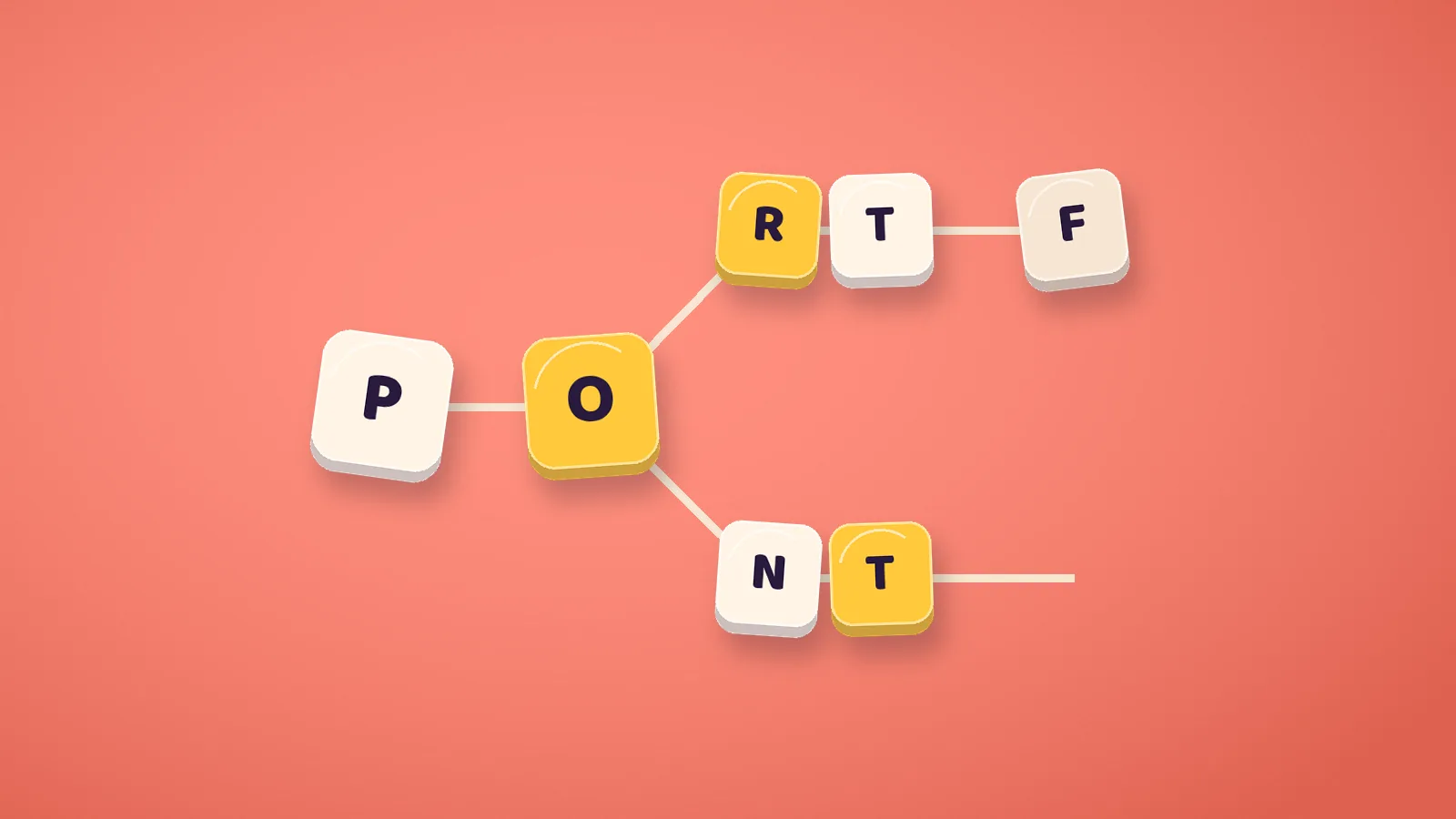
When the puzzle takes you from PONT to FORT, you might think of PORT first. You might also think of FONT, a French form of “to do,” as in “they do.” Either word reaches the target in two moves. With a different target, both would still be valid next moves from PONT, but their usefulness might change. When you’re deciding what to play first, look at the word each option would let you play next.
Start by aligning PONT and FORT. O and T are already in their place. P must become F and N must become R. This locate gives two simple tests. If you touch the first box, you find FONT. If you touch the third one, you find PORT. In each case, the rest of the task is easy to name. From FONT, you still have a N to transform into R. From PORT, it remains the P to change. You could have chosen either one or the other knowing exactly what to do next.
PONT → PORT → FORT
PONT → FONT → FORT
Sometimes a first move places the right letter without giving any obvious follow-up. In this case, give yourself a short break. Read the entire word and identify the positions that remain to be changed. Can you name another valid neighbour by keeping the letters already placed? If no word comes, formulate what you have tested. “J’ai changé le début et je suis coincé sur la voyelle” (I changed the beginning and I'm stuck on the vowel) is a usable note. You can start with a different order.
Write down two routes before choosing
On paper, write the start and draw two small arrows that leave. Next to the first, note the neighbour who is most clearly approaching the finish. On the second, note another valid word. For both, look for a continuation. The interest of this drawing is that it keeps the second track while you think about the first. In one part on the screen, you can also keep one alternative in mind and write briefly the other off the board if the challenge resists you.
Take LAC and BUS. Since LAC, BAC and LAS each place a letter of arrival. Writing the two options side by side, observes that they converge towards BAS. You do not have to decide according to an arbitrary preference. Both possibilities are equivalent for the length of this journey and one can cost you less effort to see. The comparison also teaches you a technique. When the same neighbour returns to two branches, you can examine his role only once and carry the result on both branches.
LAC → BAC → BAS → BUS
LAC → LAS → BAS → BUS
Removes from the comparison the options that you cannot confirm. A group of letters that looks like a word sometimes enters into your reasoning as if the move were acquired. Read it out loud, ask yourself if you can use it in a sentence and check the lexicon in case of doubt. A familiar neighbour has a practical advantage. You can devote the time you would have spent checking its existence to seek continuation.
Let the word’s shape guide you
When two moves leave so many letters to change, look at what each one fixes in the middle of the word. In a four-letter word, a central consonant can close several familiar possibilities. A central vowel can open others. To compare, try to complete with a loud voice a form that leaves an empty box. With P–R–T as a point of reference, placing a O in the second row immediately gives PORT. With F–R–T, the same O produces FORT. Saying the entire form avoids you recite letters at random.
The same way to help when you don't know the words of the chosen language. Reduce the choice to the neighborhoods you can read and understand. If the target is CIME and the departure RAME, RIME is easy to justify. A becomes I, then R becomes C. Both words evoke images, a rhyme and the top of a tree or mountain. The meaning here serves to validate the journey.
RAME → RIME → CIME
Compare your opening moves
Write SAC as departure and MAL as target. Try to place the M at the beginning, then observe the result. Also try to place the L at the end. Now write a neighbour whose first letter is neither S nor M, while keeping A and C. Look for a second word from this neighbour. The exercise asks you to accept a step that does not place any letter from the target. Stop for a moment before opening the course, to see what continuation you can explain.
See the route through BAC
SAC → BAC → BAL → MAL
BAC keeps A and C and changes the entry of the word. BAL places the L, then MAL places the M. The lexicon of the game also allows a road in two moves via MAC, a familiar form. The route by BAC and BAL illustrates the detour with words easier to stage.
Compare your routes after playing
A first decision is also made after the part. Take a journey that asked you for four or five moves. Indicates when each letter of the target appeared for the last time. If a letter appeared, disappeared and returned, ask yourself what this disappearance allowed. It may have prepared a necessary detour. It may also come from a branch that you could have left on the draft. To exercise yourself, write another opening and connect it directly to the first word that the two branches have in common. This comparison gives you a specific reason to prefer one of the first moves next time.
The next time two first moves try you, ask one more question before playing. "What word can I write after?" Two seconds of anticipation is enough sometimes. If the two answers remain good, choose the one you can read with an eye move and keep the second as the track back.