 ™
How to solve a word ladder backward
Start at the target, look for a word that connects both ends, and try the method on the French puzzle from ROSE to LUNE.
Game strategies
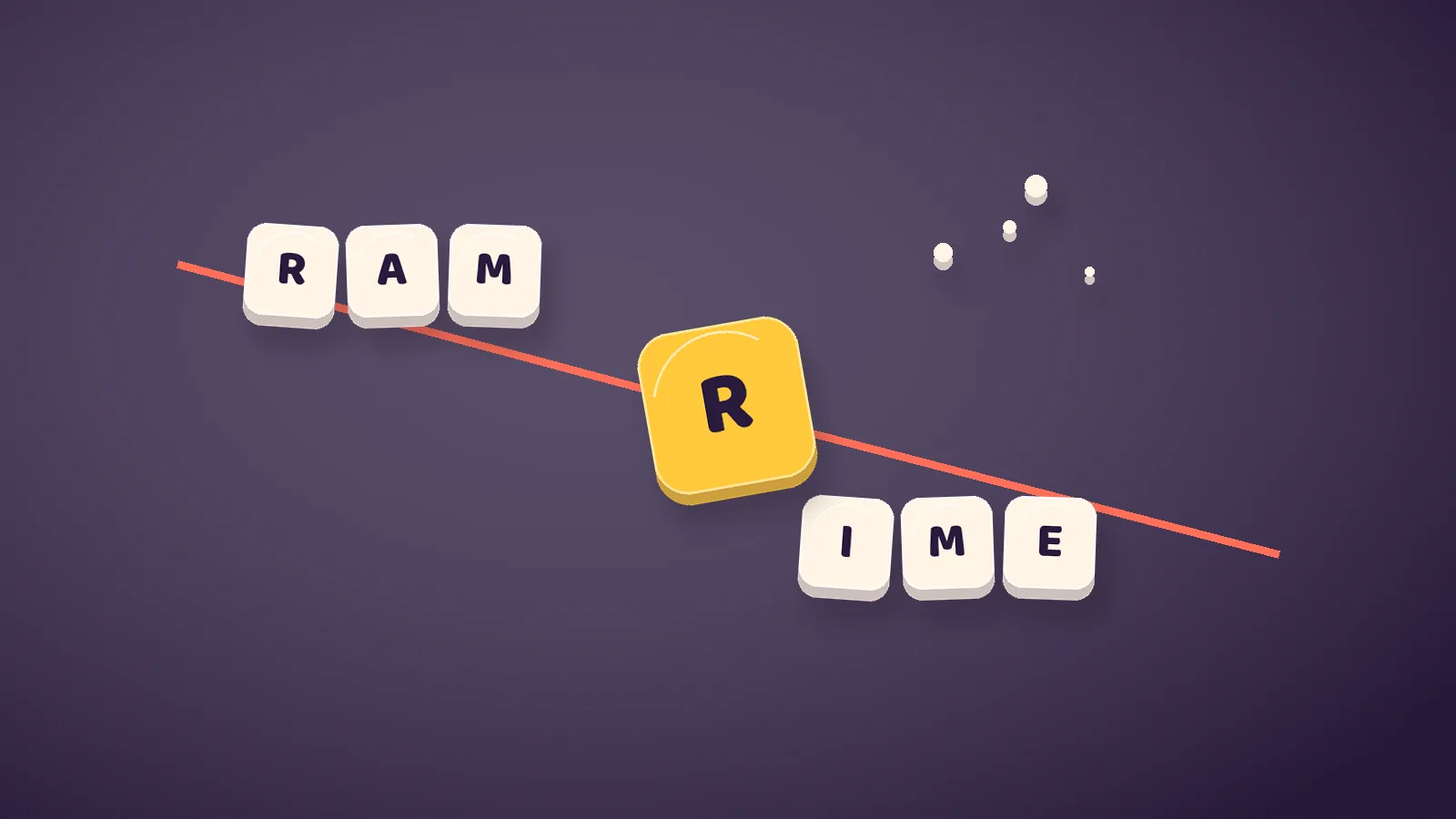
Start by looking at the last move
A neighbouring word differs by just one letter, and you can make that change in either direction. The French words RIME and CIME differ only at the first position. Replace R with C to reach CIME, or C with R to go back to RIME. If you run out of ideas at the start, look for words that can come just before the target.
Take RAME and CIME. The third letter M and the fourth E are already in place. The two differences occupy the first positions. Starting from RAME, replace A with I gives RIME. Starting from CIME, replace C with R also produces RIME. You found the junction point. Write the search in the right direction gives RAME, then RIME, then CIME. In this case, only one meeting is sufficient and the two steps only modify the necessary positions.
RAME → RIME → CIME
To see what distinguishes this method from a simple reverse, imagine that you have not yet played any move. You can look for the neighbors of CIME without touching the plateau. The word RIME becomes an intermediate objective instead of an isolated proposal. At each stage, you know which side of the course comes the word. This landmark is particularly useful when the beginning admits many neighbours and the target evokes little of it to you.
Make two short lists
Write the start in the left margin and the finish in the right margin. Under each word, write two or three familiar neighbors. Start by changing the positions where the two words do not look alike. Ask yourself if the same word appears in both lists. If there is one, check all positions. This check takes less time than trying several random word ladders. If the lists remain separate, see if a left neighbour turns into a right neighbour into a move.
Take PONT and FORT. On the PONT side, PORT and FONT are options. On the FORT side, PORT, FONT and FORE can come to mind. The first meeting is already enough to set up two moves. If you explore the other neighbours, note only those who have a chance to drive to the other edge. A list of three well-selected words is easier to consult than a full page of variants that you will have to read again.
PONT → FONT → FORT
Then try this method with a five-letter word. Starting from CARTE, you can write CARRE by changing T to R. When you leave from BARBE, you can write BARRE by changing B to R at the penultimate position. The lists do not meet immediately. However, the two intermediate words, CARRE and BARRE, are neighbouring. The C becomes B. When you put everything back in order, the stage found on the side of BARBE is written from BARRE to BARBE. It is often at this time that the reading in order helps you to confirm the last change.
CARTE → CARRE → BARRE → BARBE
What if the two lists have nothing in common?
Choose the end where you have the least options you understand. If the arrival has only one or two obvious neighbours, develop this side quickly clarifies the last possible moves. If you know better the variants of the start, advance a little on this side. The idea is to work in small steps. After adding a word, reread the other list. An easy connection to miss sometimes becomes obvious when two words are placed next to each other.
While searching, says the parent of a word with an arrow. If you only note a series of valid neighbors, you can lose the link between a word and the one who made it appear. Also keep track of the words already examined. When a branch returns to the same word, the possibilities from that word remain the same. You can reuse what you already know instead of doing all the research.
You can check the minimum length from CARTE to BARBE by counting the visible differences. C becomes B, T becomes B and the other positions are kept at the start and at the finish. Two moves would therefore represent the best possible length. To achieve it, one of the two direct changes should produce a word admitted from the first move. Check what the two direct orders give. The detour by two R shows how an intermediary can prepare a neighbour and return to the desired letter afterwards.
Try the same method with ROSE and LUNE
Draw a second pair of columns. From the start, look for a word that starts with R and changes the central vowel. From the finish, look for a neighbouring word who keeps U, N and E. If two words appear, compare them. Once the string is found, rewrite it without the columns and mark the letter modified above each arrow. You will know if you have found a real connection or two pieces that only seem to agree.
See where the two routes meet
ROSE → RUSE → RUNE → LUNE
RUSE changes O to U. RUNE changes S to N. LUNE changes R to L. RUNE is naturally from LUNE, and you can find it since RUSE. The three departure differences are settled in three moves, so the route reaches the minimum length.
Check that a neighbouring word connects the whole route
In a backward search, you sometimes think you have found a solution as soon as you recognize a good neighbour of the target. This neighbour only covers the last move. To check the road, ask which pair actually connects the two columns. Write the words of this pair on the same line, surround the different position and return the right branch in the right direction. If a word appears on both sides, write it only once in the final word ladder. This detail avoids counting an imaginary move between two identical words. Then you can read the string aloud to make sure that all the links have their place.
At the next stalemate, try this question before starting again. "What words could precede the target?" Even one well-chosen neighbour sometimes suffices to revive the reasoning.