 ™
French accents in word games
See how French words appear on WordHop tiles, then practise restoring accents by using a word’s meaning and context.
Words and languages
Two ways to see the same word
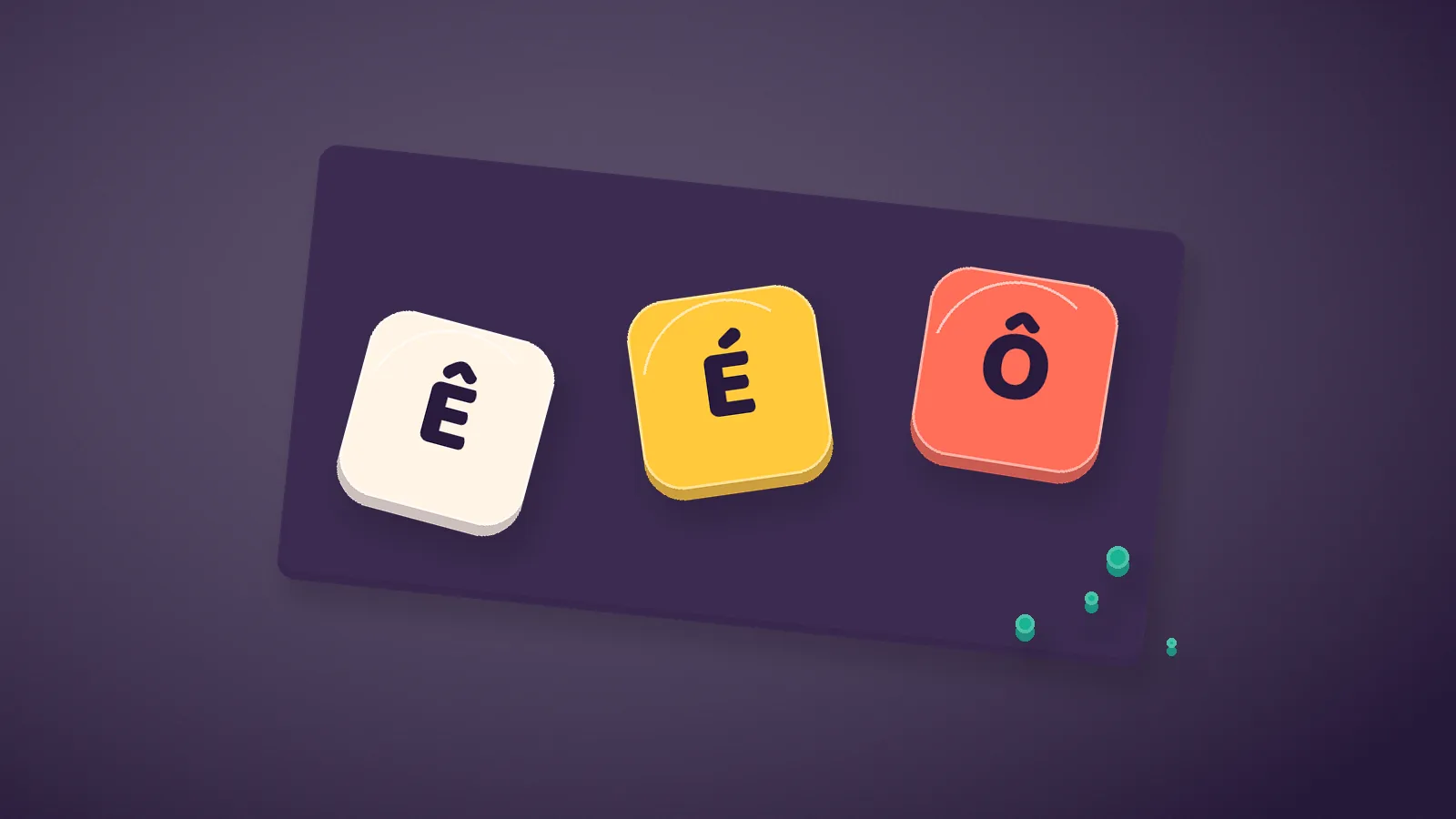
On a French WordHop tile, E can stand for e, é, è, ê, or ë. The game compares base letters when it counts a move. In ordinary French, you still write “fête” and “futé” with their accents. The tiles show FETE and FUTE, while a dictionary and your notes can show the usual spellings. Each form gives you the information you need for a different task.
FETE → FUTE
This pair allows you to see exactly what is happening. On the tiles, the second letter goes from E to U. The fourth letter remains E. If you write the usual prints, you also see the last e of “fête” and the last e of “futé”. On the screen, they correspond to the same basic letter. To check the move, compares FETE and FUTE. To read the sentence “il est futé” (He's smart), write the accent of the form you use. You can keep the two representations in your notes by placing them under one another.
Use context to identify the spelling
In the face of a series of letters without accent, the first task is to find a plausible word. The second is to choose the meaning in a sentence. COTE can make you think of a rating in a classification system, a rib that you climb or one side of the tray. The tray does not choose the meaning in your place. If you make a vocabulary sheet, a sentence can verify that you have regained the shape you wanted. “Le vélo grimpe une côte” (The bike climbs a coast) and “la pièce est de l’autre côté” (the room is on the other side) give two very different indications.
When a word comes to mind, think about its basic letters and check one position at a time. If you hesitate about the existence of the word, the dictionary can help you to confirm a precise form. Some valid words in French are not included in a game lexicon. The chosen list, the accepted bend forms and the available length influence the answers. A good explanation to someone who begins thus separates the way to write a letter from the list of accepted words.
Let's take CARRE and BARRE. In a string, you simply transmit the difference between C and B. When you want to illustrate the first by a geometric form, you write “carré”. In “la barre de chocolat” (the chocolate bar), the last e does not have accent. The senses are immediately distinguishable when you read the sentences. You can propose this game to two. Each person chooses one of the forms to explain and draws an object that allows to recognize the meaning without writing the definition.
Notice the accents away from the board
Write “fête”, “futé”, “carré”, “côte” and “côté” on five pieces of paper. Read a word out loud and look for a sentence. Then, return the paper and note the word as on the tiles of the game, in capitals without accent. Look at your result and compare it to the map. The round-trip shows you where the accent and what to put when you write the word in a text. You can make one card at a time if the sentence takes more time to find.
If you play with a child who starts to read, shows the ordinary form from the beginning and takes the time to pronounce the word. He can point out the accent he sees without having to know the name of it. In “fête”, the hat above the e is a circumflex accent. On a second map, shows “futé” and notes the small line that goes up on the last letter. Let the child redo the signs in pencil if it interests him. The line of tiles then serves to play to change a box.
With a reader more comfortable, try instead to propose sentences to complete. Write “Les bateaux rentrent au port” (The ships return to the port) and “Nous grimpons la côte” (We climb the coast), then hide one word per sentence. The challenge is to regain the form and justify his spelling, with a dictionary if necessary. When several spellings appear possible, ask which scene the phrase described. This return to the meaning is better than a guess about the accent to be added.
Try one last spelling exercise
Draw two lines of four boxes. Fill the first one with FETE and the second one with FUTE. Mark the second position, then say the two words in context. In “quelle fête préparez-vous ?” (What party are you planning?), the word evokes an event. In “son plan est futé” (his plan is smart), it is an adjective that qualifies an ingenious plan. Write each sentence. Only then, examine what signs you have added outside the boxes.
Check both spellings
In the word ladder, the modified position is the second. In the text, “fête” is written with a circumflex accent on the first E. “Futé” is written with a sharp accent on the last E. The signs belong to the written form of each word, and the calculation of the move is made on the basic letters.
A card game for words with several meanings
On a map, write a plateau form like COTE. On three others, write three small scenes. In the first, a cyclist climbs a slope. In the second, two people sit on the same side of a table. In the third, someone compares the odds of two teams. Associates the maps with the graphics and writes the words in tiny. When you connect a scene to the right term, name the shape or point the accent of the finger. You can play with someone who knows the words in the oral but who hesitates in his texts.
Keep the board card for the start of a handle and context cards for the end. The path of letters remains fast. The moment you choose a meaning gives a real question of spelling to discuss.
Keep this reflex for the other puzzles. Read the tiles according to the rules of the set, then put the word back in a sentence when you want to check the writing. You can like the game for the speed at which the letters are compared and use the dictionary for the details that the tiles don't give.