 ™
Word ladders for practising a language
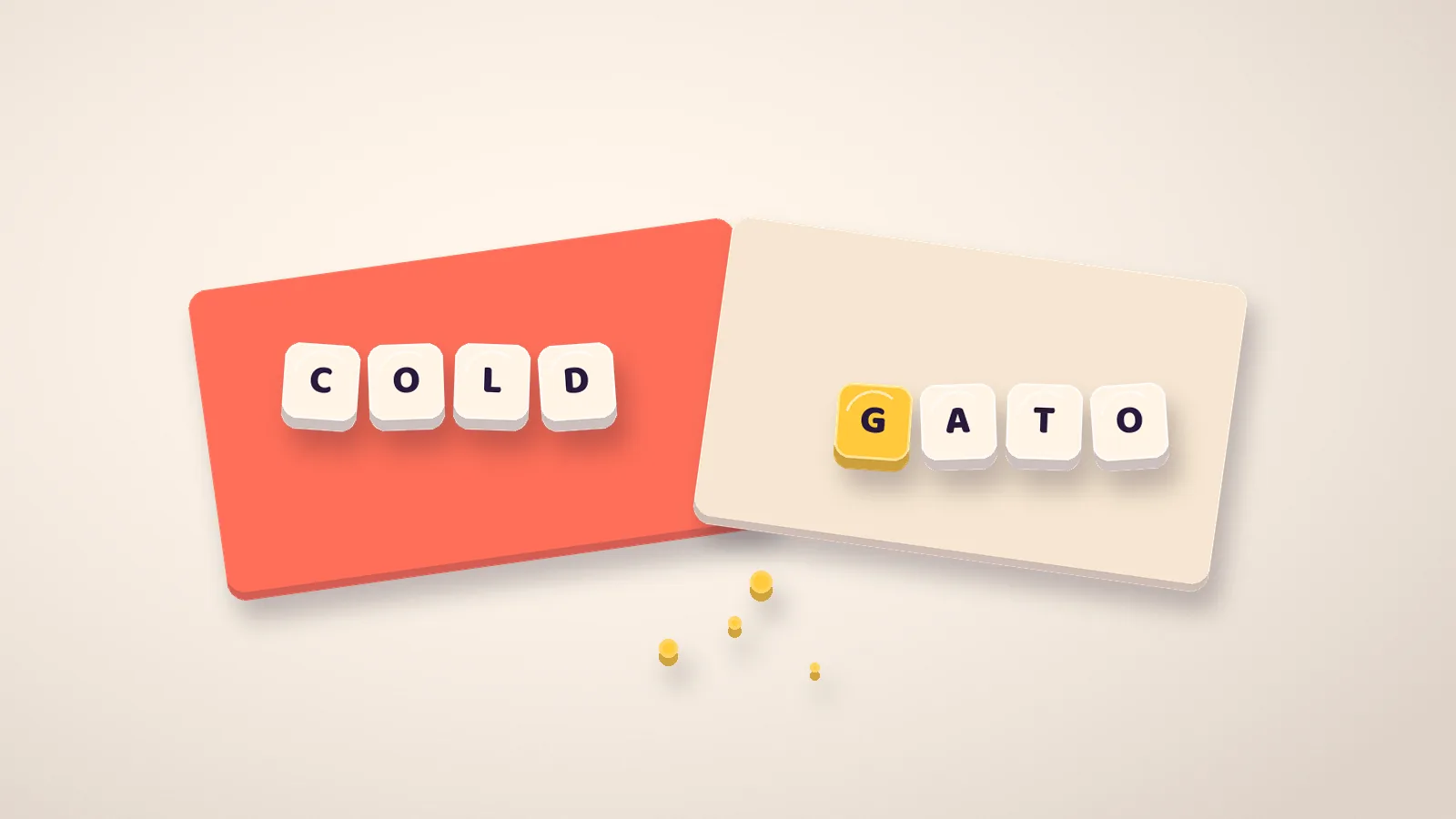
Try COLD to WORD in English and GATO to PALO in Spanish. Adapt the exercise to words you already recognize.
Learn and play at any age
Start with words you recognize
A word puzzle in another language asks two things of you. You have to find a letter to change and recognize whether the result is a valid word. Start with a route whose starting and target words you already know. Then use the intermediate words to practise vocabulary you have seen before and leave yourself room to learn one new word.
Take your time to pronounce departure and arrival. For English, try COLD and WORD. COLD means "cold" in “a cold morning”. WORD means a word, for example in “write a word”. You only need two sentences that you can understand. Write each word on four boxes, then compare the first and third. The second and fourth letters are already correctly placed. One move touches the middle and the other touches the beginning.
In English, from COLD to WORD
You will keep O and D. Try to transform the L into R. You get CORD, which can designate a cord. Write a short sentence to distinguish it from COLD. “The cord is long” can evoke a cord that you branch or hold. Now, change C to W to get WORD. Repeat the three words with their meaning, then return the list and try to find the graphs from the examples.
COLD → CORD → WORD
If another path has come to you, keep it and check it. In English, WOLD can designate a region of hills and is another solution in the lexicon. The journey by CORD favours a word that many learners can attach to an object. In your notebook, you can note the first path that you can explain. The purpose of this session is to make the link between a graphic and what the word means. You will always have the opportunity to explore other neighbours afterwards.
Now exercise with a small variation. Put CORD in a sentence that you would be likely to say. If you want to talk about a charging cable, look at how an English-speaking person names it in this context. The translation changes according to what you are talking about. Tent a sentence with WORD and choose a verb that you know. Returning to context allows you to work words long after the resolution of the word ladder.
In Spanish, from GATO to PALO
Take the four boxes back. GATO means a cat and PALO can designate a stick. In this puzzle, the change can start with G. Replace it with P to read PATO, which means a duck. Then, replace T with L to read PALO. Associates an image with each of the three names. A concrete image makes it easy to see when you are wrong when you rebuild the example.
GATO → PATO → PALO
Then extend the activity with a short sentence. You can write “El pato está cerca del agua” and "El gato duerme". If the sentence seems difficult to you, keep only “el pato” and "el gato", then draw the two animals. If you already know these words, try to build a path to PALA, which can designate a shovel. The last substitution creates a new destination without changing the other boxes.
GATO → PATO → PALO → PALA
Adapt the practice session to your level
Prepare three small cards. On the front, write the word. On the back, write a scene or draw a simple drawing. Place the three cards on the scene and see if you can find the words before returning them. Then, place the cards in the order of the course. If you block on the spelling, leave the first and last letters visible in a hole line. You can remove the help to the second attempt if it becomes useless.
In duet, one person reads a clue in the chosen language and the other moves a tile. Reverse the roles in the middle of the path. If you don't know the pronunciation of a word, take the time to consult it after the move. You can also play silently and read the words only at the end, especially if the purpose of the session is to focus on writing. By choosing one task at a time, you make the exercise easier to resume tomorrow.
Try the exercise with a partner
Ask another person to choose the route in Spanish or English. Give only the departure and the target, then prepare a drawing or object corresponding to the intermediate word. If you play with a person who knows the language well, ask him or her to invent an example of a phrase that he or she would really use. If you both learn, keep the sentences very short and reread them after finding the route. Each participant chooses a word that he or she wants to keep and offers his or her graphic, pronunciation or meaning at the end of the session.
You can also turn the path into a two-tiered guess. A first clue indicates the position on the set. A second one describes the object or animal. For PATO, the first one asks to replace G, and the second one speaks of an animal that is sometimes seen near the water. The person can open the index that is most useful to him. If he already visualizes the animal, he can concentrate on writing. If he directly recognizes the shape of the word on the tiles, he can discover the meaning afterwards.
In the end, compare your two shorter sentences. Ask yourself which one you could use as it is tomorrow. You now have a way to review the vocabulary without automatically reconstructing the whole word ladder. If you want to go back, each sentence can serve as a new clue to find its word.
Finally, try to note a familiar word and a new word. Write a sentence with the new word and reread it later in the week. If the words of the journey are still difficult to distinguish, redo the little course in the other direction from the arrival. This round-trip gives you an opportunity to review the same scripts under another order. Then you can move on to a new riddle by taking back what has helped you today.